
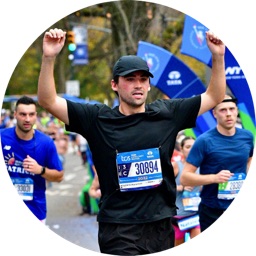
Why Michigan Is a Surprisingly Strong Marathon State
Ask most runners to name a Michigan marathon and they'll say Detroit. That's the floor, not the ceiling. The state actually spans a rare range: a big-city international race with a border crossing, a lakeside flat with one of the highest BQ rates in the Midwest, a remote Upper Peninsula course with 810 feet of net drop and a Lake Superior backdrop, a solid fall metro option in Grand Rapids, and a rolling city race in Kalamazoo for runners who want a tougher test. You have legitimate options for every goal. The problem is knowing which one fits yours.
Timing helps too. Michigan's fall race season runs September through October, when average highs sit in the upper 50s to mid-60s. That's structurally good weather for marathon performance, and it makes the fall calendar the natural planning target for most runners right now.
*Marquette is listed as flat in our catalog but carries 810 feet of net drop over its course, a meaningful structural advantage on race day.
Best for a PR: Bayshore Marathon
If your goal is a personal best and you want Michigan's most proven fast course, Bayshore is the answer. The out-and-back route runs along Grand Traverse Bay on flat terrain with a 2,000-person field, big enough for energy and pace groups, small enough to avoid bottlenecks. That 19% BQ rate doesn't happen by accident. The course gives you every structural advantage: no hills to drain your legs, manageable crowds, and water views that make the back half easier to tolerate mentally.
There is one honest tradeoff. Bayshore is a May race, which means your peak training block runs through a Michigan winter. February and March long runs in cold and dark are a real commitment. If you thrive in cold-weather base building, that's a non-issue. If you struggle to hit weekly mileage when it's 18 degrees and icy, factor that into your decision.
Registration opens in December and the race sells out quickly. If Bayshore is your target, mark your calendar in November. See The Flattest, Fastest Marathons and The Best Boston Qualifier Marathons for how Bayshore compares nationally.
Best for a Boston Qualifier: Grand Rapids Marathon
Bayshore has the higher BQ rate. So why does Grand Rapids get the BQ pick? Timing. For most runners, a fall qualifier fits the training calendar better, and October racing conditions are harder to argue with: 60°F average high, mostly flat course, and a field of 1,158 that's large enough to find your pace group without being large enough to become a logistics headache.
The difference between Bayshore and Grand Rapids isn't really course quality, it's cycle fit. If your goal is to qualify and you want a fall attempt, Grand Rapids removes the winter training variable entirely. You build through summer, peak in September, race in October. That's a cleaner arc for most BQ chasers.
One sidebar worth noting: a separate small September event called Last Chance BQ GR runs at the same Grand Rapids venue. If you need a September window rather than October, that race exists as a fallback option, though field size and course details aren't in our catalog. For the full context on BQ-optimized races, see The Best Boston Qualifier Marathons and The Best Fall Marathons.
Best for a First Marathon: Detroit Free Press Marathon
For a first marathon, the goal isn't a time. The goal is to finish with your motivation intact and a story worth telling. Detroit delivers both. Flat course, 58°F average high in October, and the largest field in Michigan means you get pace groups at every interval, crowd support through most of the course, and more on-course energy during the miles when you need it most.
The course also does something no other Michigan race can: it crosses the Ambassador Bridge into Windsor, Ontario, and returns through the Detroit-Windsor Tunnel. For a first-timer grinding through miles 18 to 22, that border crossing is a genuine distraction and a genuine memory. It's not just marketing. The course structure gives your mind something to hold onto at the hardest point.
Be honest with yourself about the tradeoffs. A field of 3,569 means corrals, port-a-potty lines, and more pre-race logistics than a small local race. If you're the kind of runner who wants quiet and simplicity on race morning, that's a reason to look at Marquette instead. But if you want the full big-race experience for your debut, Detroit is the right call.
The 3% BQ rate here is worth naming clearly. This isn't a PR-optimized course for most runners. It's a completion and experience race. Set your expectations around finishing strong, not chasing a qualifier.
Best for Scenery: Marquette Marathon
Marquette is rare. It has the highest BQ rate of any Michigan race in our catalog, an 810-foot net drop, a 448-person field that keeps the experience low-key and community-oriented, and it runs through Upper Peninsula forests and along the Lake Superior shoreline. Most races make you choose between fast and beautiful. Marquette doesn't.
The small field is the defining characteristic. This is not Detroit's energy, and it's not trying to be. If you want a meditative, bucket-list race where you can hear your own footsteps and actually see the scenery instead of the back of someone else's singlet, 448 runners is exactly the right size. The race happens in early September, which fits neatly into a fall training cycle as a hard tune-up or a race-season opener.
The 810-foot net drop is legitimate free speed, the kind that can pull your time forward through the first half. Just know that fast early miles on a downhill course can cost you in the final stretch if you don't pace conservatively. For more races with meaningful elevation assistance, see The Best Net-Downhill Marathons and The Best Fall Marathons.
Best for a Challenge: Kalamazoo Marathon
Kalamazoo is the honest 'character course' pick. Rolling terrain, a spring May date, roughly 60°F average high, and a city atmosphere that's different from Michigan's fall-dominant lineup. Our catalog doesn't have BQ rate or field size data for Kalamazoo, so we won't pretend otherwise.
What we can say: if your goal is a PR or a qualifier, choose Bayshore or Grand Rapids. The rolling course and data gaps make Kalamazoo a harder bet for time-focused runners. But if you want a harder test, a spring race on varied terrain, and a smaller-city event feel, it's a legitimate choice for the runner who values the experience over the clock.
How to Choose: Michigan Marathon Decision Matrix
Here's the short version. Chasing a BQ this fall? Go to Grand Rapids. Want flat and fast in May with Michigan's best BQ rate? Bayshore. Running your first marathon and want the biggest event in the state? Detroit. Upper Peninsula bucket list with a legitimate fast course? Marquette. Want a harder, hillier challenge on rolling terrain? Kalamazoo, eyes open on the data gaps.
- 01PR or BQ in fall: Grand Rapids Marathon (October, 60°F, mostly flat, 8% BQ rate)
- 02PR or BQ in spring, highest BQ rate in state: Bayshore Marathon (May, 69°F, flat, 19% BQ rate, register in December)
- 03First marathon, biggest field, bucket-list course: Detroit Free Press Marathon (October, 58°F, flat, 3,569 finishers)
- 04Scenery plus legitimate speed: Marquette Marathon (September, 66°F, 810-ft net drop, 22% BQ rate, 448-person field)
- 05Rolling challenge, spring timing: Kalamazoo Marathon (May, 60°F, rolling, BQ rate and field size unknown)
A note on registration timing: Bayshore sells out fast after December opening, so act early if that's your target. Detroit and Grand Rapids have rolling registration but tend to fill by midsummer for their October dates. If you're reading this in July and haven't registered, don't wait another week.
Browse the full catalog at The Best Marathons in Michigan for complete stats on every race in the state, including The Best Fall Marathons and The Best Boston Qualifier Marathons for cross-state comparisons.